Daily · Sep 09, 2026 · 5 min read
Per-phase model routing cuts agent cost, RASER on Slurm, Amp steers mid-run
Plus: 2 papers, a context-mode split, and OpenAI's Navier-Stokes claim. 5 min.
Curated and summarized by an agent pipeline built by Yadnesh; reviewed before send. How this is made →
The lead
blog post · Story page
A post on Arize describes splitting a recurring coding-agent workflow into four phases, planning, exploration, implementation and review, and routing those phases to different models and harnesses.
- The details:
- The reported result is one workflow falling from roughly $100 per run to $15 to $20. The author describes routing planning, exploration, implementation and review to different models and harnesses.
- Yes, but:
- It's one author's before-and-after on one workflow. The headline number carries no quality measure alongside it, so the claim alone can't tell you whether the cheaper run does the same work.
- Why it matters:
- If you run a recurring agent job on one frontier model end to end, this suggests checking how the harness routes work. The author routes planning, exploration, implementation and review to different models, but the reported cost figures alone do not establish the effect on quality.
- An engineer reports cutting the cost of a repeated task that uses artificial intelligence to write computer programs.
- Different systems handle planning the work, exploring the code, writing changes, and checking the results.
- The engineer says the change brought their cost per run from roughly $100 to $15-$20.
Research & Papers
02
paper · Story page

RASER runs agent workflows on Slurm with work stealing through shared-filesystem queues, application-level checkpointing paired with Slurm requeue, and Apptainer isolation without image changes. It reports nearly 39% lower makespan than static partitioning at near-full CPU utilization, and it tests recovery after simulated preemption.
- Researchers built software to organize unpredictable tasks performed by artificial intelligence across groups of powerful computers.
- When one computer finishes its work, it can take waiting tasks from a shared list.
- The software saves progress so interrupted tasks can restart.
- In tests, large computing jobs took nearly 39% less time than when computers received fixed task assignments.
paper · Story page
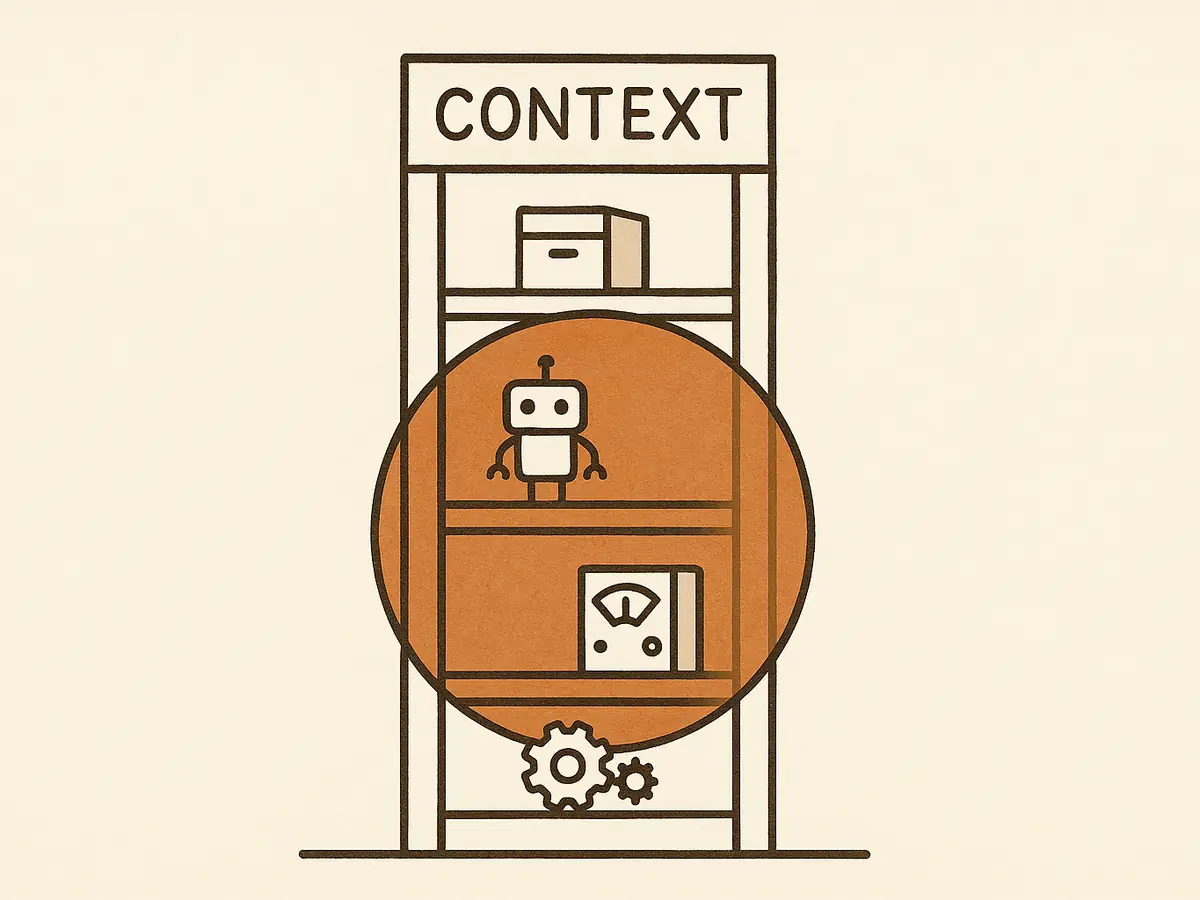
A position paper argues that as models improve they absorb the system layers built to cover their limits, and that what stays worth building is persistent semantic context about the data environment, served as a first-class abstraction.
- Researchers argue that better artificial intelligence could make some tools built around today's systems unnecessary.
- Those tools make up for limitations that future systems may overcome on their own.
- The researchers propose storing reusable background information that helps the software understand the data it works with.
- The researchers argue this background information could help software answer questions about huge, complicated collections of data.

Engineering & Harnesses
04
Deepagents now lets a subagent fork the supervisor's context or start isolated, which LangChain frames as the answer to what each subagent should see. Speed, cost and focus are stated as aims, not measurements.
- LangChain added a way to choose what information each artificial intelligence helper starts with.
- A helper can copy the information available to the coordinating system or start separately without inheriting it.
- LangChain says these choices are intended to make work involving several helpers faster, cheaper, and more focused.
blog post · Story page
A GitHub Actions pipeline deploys an agent and an OAuth-protected MCP server to AgentCore runtime, fires test prompts, scores the answers and blocks the pull request when behaviour regresses. Vendor walkthrough, but the shape, agent evals as a merge gate, transfers.
- Amazon describes automatic checks for proposed changes to software that uses artificial intelligence.
- The setup runs the software, gives it test instructions, and scores its answers.
- If test results get worse, developers can automatically block the code change from being accepted.
Reddit thread · Story page
A 400 MB Qwen3-0.6B on a 2017 Galaxy Note 8 drives desktop Chrome by picking one named element from a structured page of about 10 links or fields. Extraction, clicking and verification sit in the surrounding stack, which the poster helps build, so the scaffold is the story.
- A project contributor demonstrated artificial intelligence running on an old Samsung phone directing a computer's web browser.
- The phone chooses one item by name from a short list of links or fields.
- Other software prepares the choices, clicks the selected item, reads the facts, and checks the results.
- For developers using small artificial intelligence systems, the example shows how supporting software can do most of the browser work.
vLLM walks through KV cache management, parallelism, scheduling and prefill/decode disaggregation for agent traffic, and reports up to 130K tokens per GPU-second on SemiAnalysis AgentX plus a 14.6x to 106x serving-cost advantage over Opus 5. Those are the project's own numbers.
- A software team explained how it runs artificial intelligence systems that carry out tasks while keeping computing costs down.
- The software reuses saved information from earlier processing.
- It separates the work of reading requests from the work of producing answers.
- The team reports lower computing costs than Opus 5 for companies running these tasks, based on its own tests.
Product & Releases
01
blog post · Story page
Amp now delivers a message you send mid-run at the next possible opportunity instead of holding it until the turn ends, so a correction lands before the agent runs verification you no longer want. Ship, Review and other built-in actions still queue.
- Amp now lets you redirect its artificial intelligence assistant while it is still working.
- Your message reaches the assistant at its next opportunity, instead of waiting until its current work ends.
- Built-in actions such as Ship and Review still wait until the assistant finishes its current work.
- Users can change instructions before the assistant spends time checking work they no longer want.
From X
01
X post · Story page
OpenAI says around 10,000 coordinating agents on a next-generation model it calls significantly more capable than GPT-6 Astra produced an analytical proof and a Lean formalization that a Navier-Stokes fluid can develop a finite-time singularity, in 88 hours. It's OpenAI's own claim; the thread does not say the proof has been independently reviewed.
- OpenAI says its artificial intelligence solved a major mathematics problem about how fluids move.
- The proposed proof describes fluid spiraling inward and stretching until the mathematics describing its movement breaks down.
- The company says cooperating programs produced both a mathematical argument and a version written for a computer to check.
- The post does not say whether independent experts have reviewed the claimed proof.
- If confirmed, the result would help mathematicians understand when equations describing fluid movement can break down.
Quick links
- I-have-ADHD: A skill to stop coding agents from burying the answer (Hacker News)
- Extending concurrent separation logic to the hardware level to verify the xv6 OS kernel on RISC-V with AI agents (Semantic Scholar)
- I Asked 100 Agents to Hack Me (Shrivu Shankar)
- Inside the ID-JAG: How enterprise-managed authorization actually works (WorkOS)
- Announcing Mastra Factory Beta (Mastra)
- Optimizing delta weight syncs for managed rollouts (Baseten)
- Latency-Aware Orchestration for Multi-Agent LLM Workflows on Heterogeneous GPUs (Semantic Scholar)
- Evolving transition-state search with agentic large language models (Semantic Scholar)
Meme of the day
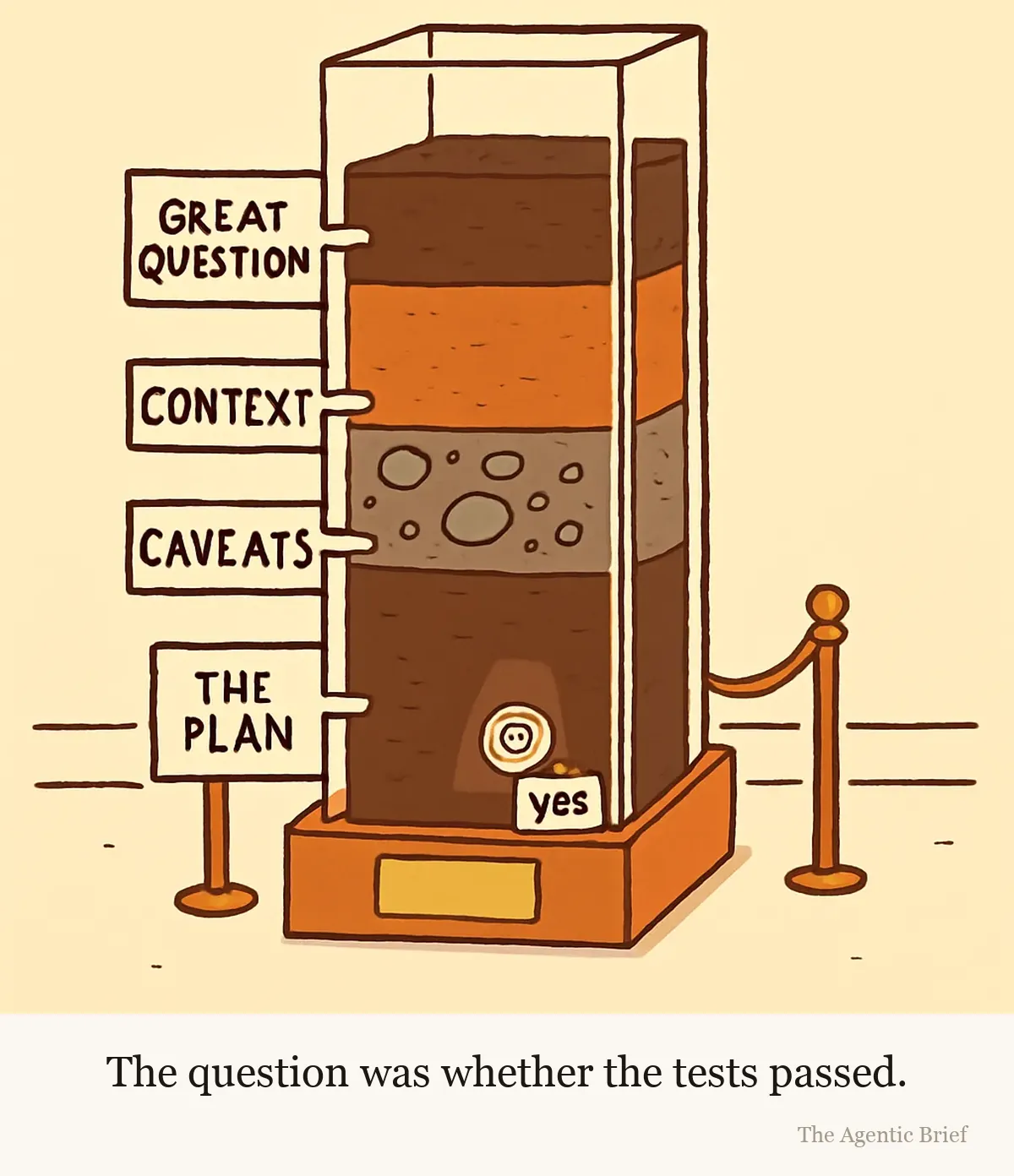
Drawn by an image model.
Corrections
Nothing to correct.
Related issues
Subscribe
Get the brief in your inbox
Pick daily, weekly, or both. Nothing is gated either way: every issue is on the site and in the feeds.
- Weekdays at 8:45am IST, one lead story and 6 to 9 items.
- Sundays, an argued synthesis rather than a recap.
- One click to leave, and quiet days say so in the subject line.