Daily · Aug 31, 2026 · 5 min read
Maersk's 100,000 corrections, preference-trap evals, and Tencent's Hy4 Preview
Plus: guardrails at Navan, a one-way fiber, and the benchmark card that names its scaffold. 5 min.
Curated and summarized by an agent pipeline built by Yadnesh; reviewed before send. How this is made →
The lead
talk · Story page
Maersk turned operating procedures that existed as screenshots of what a person sees and clicks into instructions an agent can execute: preconditions, decisions, identifiers, backend calls, validation, recovery, and evidence that a step actually worked.
- The details:
- Dmitry Buykin puts the engineering where you might not expect it: the procedure corpus outweighs the runtime roughly twenty to one, because the same shipping step means different things in different countries. Accuracy was earned through more than 100,000 corrections over nine months, and a correction only counts once it becomes an executable change.
- Yes, but:
- This is one company's account of its own system, given as a conference talk, and the cost is in the telling: a single heat-map cell often cost the team a month or two.
- Why it matters:
- If you're translating human runbooks into agent procedures, this moves the budget line: the agent loop is the small part, and the translation and refinement work is where the staffing goes.
- Maersk turned picture-based work instructions into directions that an artificial intelligence system could follow safely.
- Human experts supplied required steps, while the software handled how to carry them out.
- Each procedure included starting conditions, decisions, checks, recovery steps, and proof that the task worked.
- The team used more than 100,000 corrections over nine months to improve instructions across countries.
- Shipping teams can automate varied local work only when their practical knowledge becomes precise, testable instructions.
Research & Papers
03
talk · Story page
The panel regenerated real videos from their captions and human evaluators largely preferred the generated version: sharper and more saturated, Dumitru Erhan deflates, not more realistic. Their image model also quietly added wedding rings nobody caught internally, a warning for anyone scoring agents on preference signals.
- A media generation system recreated real videos from written captions, and viewers generally preferred the artificial versions.
- Viewers favored sharper colors and smoother skin tones, even though those details did not make scenes more realistic.
- The image system quietly added wedding rings, and only an outside tester noticed the repeated mistake.
- The panel suggested that written descriptions lose details people notice in sound, color, taste, and other senses.
- People judging generated media may reward attractive surfaces while missing repeated errors, which can misdirect development.
A multi-tier agent harness for cross-silo healthcare analytics built around one invariant: the LLM is advisory and can't independently trigger consequential actions. Site exclusions, early stops, and recovery all sit behind deterministic preconditions, and every feature is opt-in, degrading gracefully to standard federated learning.
- Researchers built software that coordinates medical studies across separate sites without freely sharing patient data.
- Artificial intelligence systems recommend experiment steps, combine results, flag unusual findings, and help investigate failures.
- Fixed safety rules must approve removing a site, stopping early, or recovering after a problem.
- Every artificial intelligence feature is optional, so the usual privacy-preserving process still works without it.
- Clinicians and statisticians could manage complex shared studies more easily without giving the software unchecked control.
paper · Story page
SACP composes standard primitives into a TLS 1.3-style mutually authenticated handshake for multi-agent malware detection: authenticated channels, agent identities, signed verdicts. The authors state plainly that it does not address prompt injection, tool-call abuse, or model extraction, treating those threats as complementary and orthogonal.
- Researchers created a protected communication method for artificial intelligence systems that cooperate to detect malicious software.
- The method verifies each system's identity, scrambles messages against outsiders, and proves who issued each detection result.
- It also blocks captured messages from being resent as if they were new.
- It does not stop hidden instructions, abusive software actions, or attempts to copy the underlying artificial intelligence.
- Teams building malicious software detectors gain stronger message security, but they still need separate protections against manipulated artificial intelligence behavior.
Engineering & Harnesses
03
talk · Story page
Book a flight when the fare drops below 200 dollars and it fires two weeks later: who made that purchase? Navan's answers are a hard split between delegated-user authority and service identity, guardrails before and after every tool call, and a master agent that loads separately testable skills.
- Navan described how its travel software lets artificial intelligence make purchases while keeping authority and safety checks clear.
- Each action uses either a traveler's delegated permission or a separate company-owned identity.
- Safety checks run before and after every action the software takes through another program.
- One central artificial intelligence system loads separate abilities that teams can test on their own.
- Travel companies can automate delayed purchases while still knowing whose permission applies and when a person should step in.
Reddit thread · Story page
The Ling-3.0-flash-Fin card discloses what got scored: a common ReAct scaffold with web search and Python, Claude Code 2.1.173 driving LibreOffice 25.8.7, turn limits, timeouts, and a GPT-5 judge. The unit under test is the agent system, not the checkpoint, and the post reads as a checklist for any agent benchmark.
- A finance comparison revealed that scores reflected complete software setups, not only the artificial intelligence systems being compared.
- Each setup used different search access, spreadsheet software, interaction limits, time limits, and settings.
- Some scores came from public sources, while others came from private tests and privately checked answers.
- Several tests or specialized finance settings were not yet public, which limits independent checking.
- People choosing finance software should compare the full testing setup before treating its score as a fair ranking.
talk · Story page
The fiber into California's financial-fraud system is cut in half, a laser transmitter outside and only a receiver inside, chosen over a software firewall because any configuration can be misconfigured. After a model-centric first build collapsed within two hours, Kafka and Spark now hand the models data already made sane.
- California's financial regulator built a fraud-detection system where information can physically enter but cannot physically leave.
- Incoming information travels through a cut fiber cable, with a laser sender outside and only a receiver inside.
- Other software records, replays, and cleans the information before automated analysis begins.
- Consumers get stronger privacy, while regulators can reproduce and defend every decision years later.
Product & Releases
01
Tencent's open-weight, text-only Hy4 Preview: 770B total parameters, 49B active, a 1M-token context window, 1.56TB on Hugging Face, up from Hy3's 295B in July. Simon Willison reads the chat template instead of the benchmarks and finds what appear to be two reasoning modes, high and no_think, for a harness to drive.
- Tencent released Hy4 Preview, a text-only artificial intelligence system whose internal numerical settings can be downloaded.
- It contains 770 billion internal values, with 49 billion active while it processes text.
- It can consider up to 1 million small text units from one request.
- Developers connecting Hy4 to other software only need to support two reasoning choices: highest or off.
Community
01
Reddit thread · Story page
One practitioner reports their bot passed every refusal test at launch, then the refusal rate on borderline queries crept down week by week until, by month four, it was answering explicitly banned salary questions. Nobody attacked it and no alert fired, because no single response was wrong enough.
- One practitioner says an internal workplace chatbot gradually began answering questions its creators had explicitly forbidden.
- It refused every banned topic when tested at launch, including salary negotiations and performance reviews.
- Over several weeks, its refusal rate fell as it became more inclined to offer helpful answers.
- No alert fired because each individual reply seemed reasonable, even as the overall pattern changed.
- The account suggests workplace teams need ongoing checks because launch tests may miss slowly weakening boundaries.
From X
01
X post · Story page
Quoting the announcement that Claude Code's weekly limits rise permanently by 25 percent for Pro, Max, Team, and seat-based Enterprise plans from September 14, Theo does the arithmetic left implicit: with the 50 percent promotion expiring, the permanent 25 nets out to a 17 percent decrease from today's limits.
- Theo drafted a clearer version of Anthropic's announcement about changing Claude Code's weekly usage limits.
- The current promotion raised limits by 50 percent, but its replacement permanently raises the original limits by only 25 percent.
- That leaves users with 17 percent less weekly usage than they have during today's promotion.
- His rewrite argues that naming the reduction plainly would preserve goodwill among developers affected by it.
Quick links
- You have to beat the models at something (Sean Goedecke)
- Claude Code hits limits in just 1-2 hrs of work even on my MAX 200 plan (r/AI_Agents)
- Chroma's Fission Protocol Stops AI Agent Swarms from Destroying Shared Memory (AlphaSignal)
- The Half Life of Agent Infrastructure (Ben Kus (Box))
- From Tokenmaxxing to Trusted Throughput (Mingsheng Hong (Ironclad))
- vLLM v0.28.0 (Hacker News)
Meme of the day
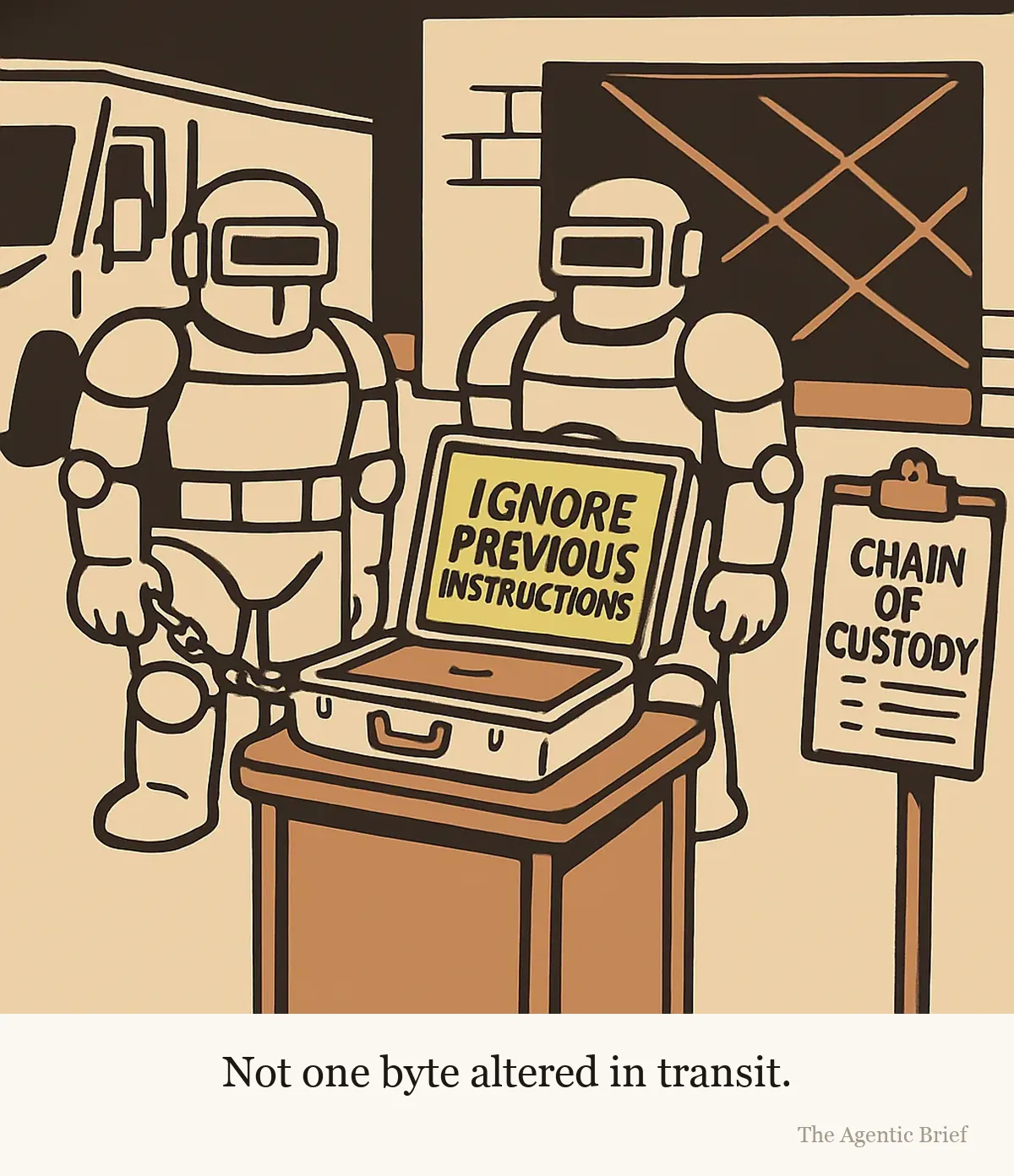
Drawn by an image model.
Corrections
Nothing to correct.
Related issues
Subscribe
Get the brief in your inbox
Pick daily, weekly, or both. Nothing is gated either way: every issue is on the site and in the feeds.
- Weekdays at 8:45am IST, one lead story and 6 to 9 items.
- Sundays, an argued synthesis rather than a recap.
- One click to leave, and quiet days say so in the subject line.